Transport as of June 2026
At the bottom of this page is the original posting from the launch of the web site four years ago in 2022. I have left it to show how quickly things have changed in only four years.
In Europe we do have Electric car manufacturers but the capability of building batteries at scale has not been successful so prices are still high and are not able to reach a mass market. Tesla cars are high end and expensive.
For a mass market of inexpensive Electric cars, I will be talking a lot about China. It is important to understand what is driving China and to have some comprehension of what is going to happen in the future. (As background, in Victorian times the European Nations treated China very badly and caused “Loss of Face” for the Chinese Nation which was culturally very difficult.)
China is not now a backward country. In 2025 they registered over 1 million patents, and in business they are fiercely competitive.
The main driver for China is that it lacks oil resources and the delivery of oil from the Middle East comes through two pinch points of narrow channels for ships, the Strait of Hormuz accessing the Persian Gulf, and the Strait of Malacca between Indonesia and Malasia. The Chinese are driven to electrify everything so their fossil fuel use has already plateaued. China has a population 17 times bigger than the UK, and our renewable electric generation on average is about 30 gig watt (GW) installed over the past 20 years. In 2025 China installed 430 GW making a total of 1,800 GW of renewable generation. To compare we should have 105 GW in the UK. So many commentators say we are doing well on renewables but we are not doing as well as we could.
High Speed Electric Trains reduce the need to use fossil fuel in aeroplanes
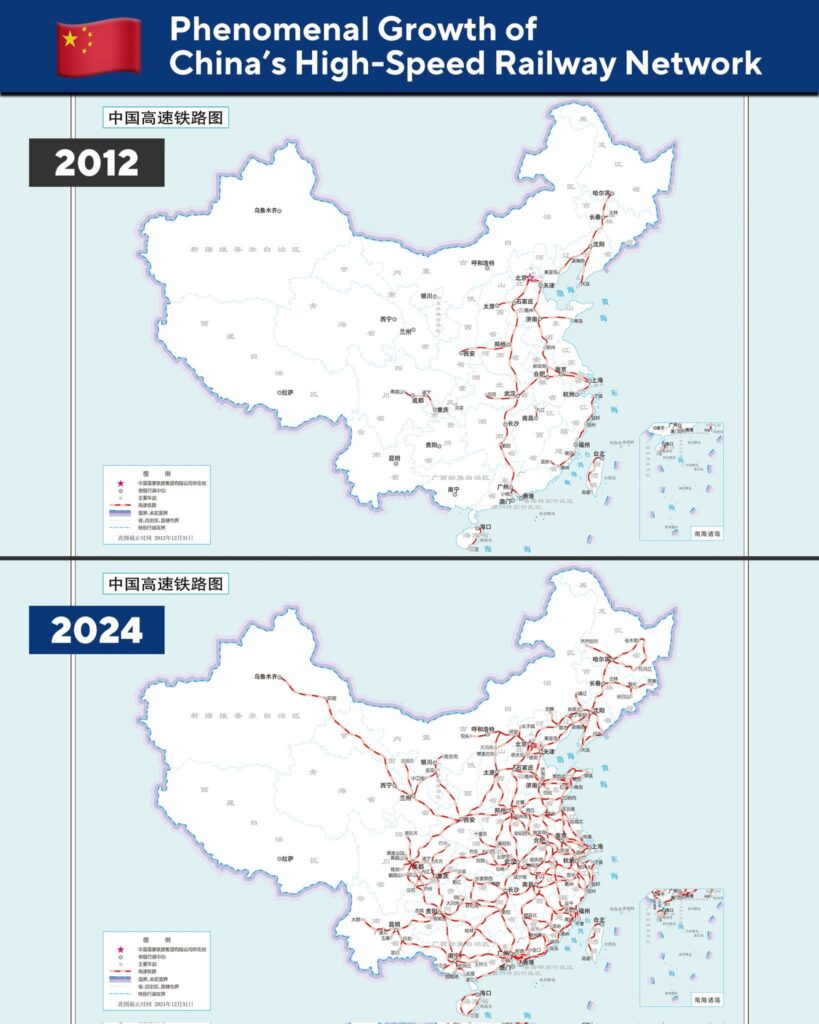
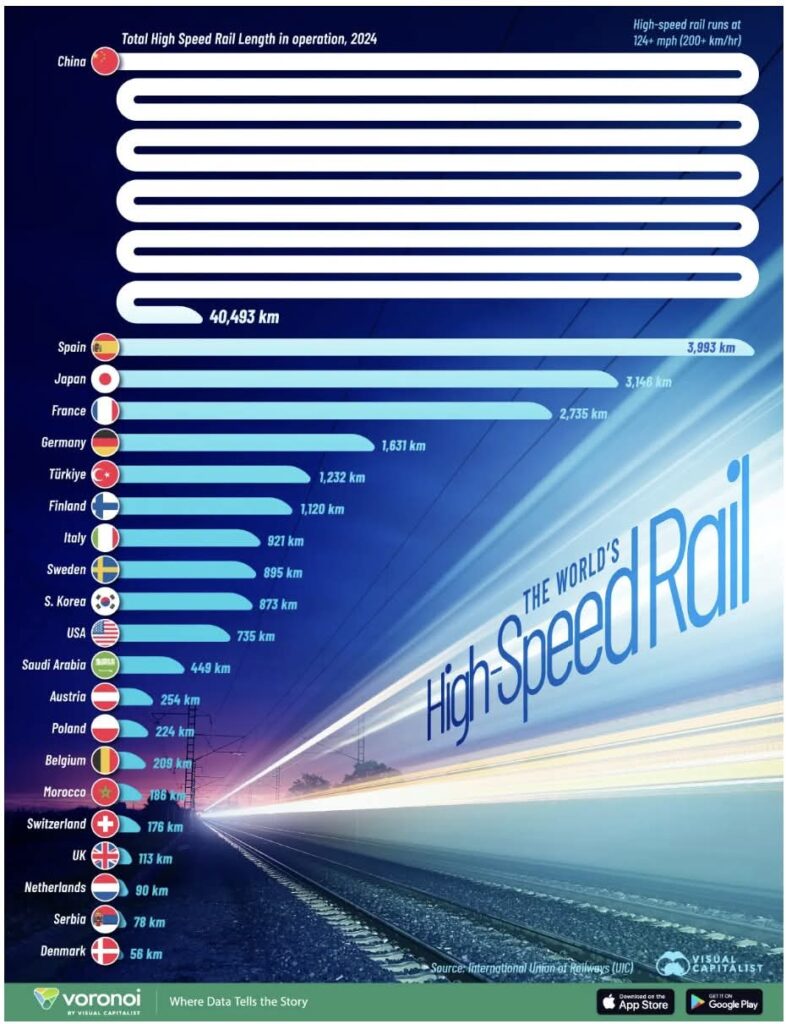
By 2024 China had installed a total of 40,000 km of High-Speed Railways in only a 12-year period. This means that China does not need to use much fossil fuels for internal air traffic as people can use High-Speed Railways. (The population of the USA is a quarter of that of China and they only have 735 km of high-speed trains.)
Truck Transport
In 2022 I said “I suggest batteries are not the future for large vehicles” because they did not seem to be powerful enough. I was not aware that by 2017 Shenzhen, a city in China, had replaced its 16,000 diesel buses with electric. London with half that population now has 3,000 electric buses. As of now (2026), about 16% of trucks in China are electric and 30% of new heavy-duty truck sales are electric using a battery swapping infrastructure.
Batteries
The increased use of electric vehicles (EV’s) is obviously dependent on suitable batteries. In the past ten years the cost of batteries has dropped in price by 90% as has solar panels. CATL in China has recently developed a Sodium Ion battery without using expensive Lithium, and the technology of batteries is moving so fast that worldwide, countries that have high annual sunshine with a lot of solar power plus batteries can have electric power 24 hours a day.
The Chinese car manufacturer BYD that started off making batteries for mobile phones in the 1990’s are now building a car factory in Zhengzhou that has a 30 square mile surface area, and they have built eight ships that are delivering 1 million cars annually. They are also building six factories outside of China including Hungary and Turkey.
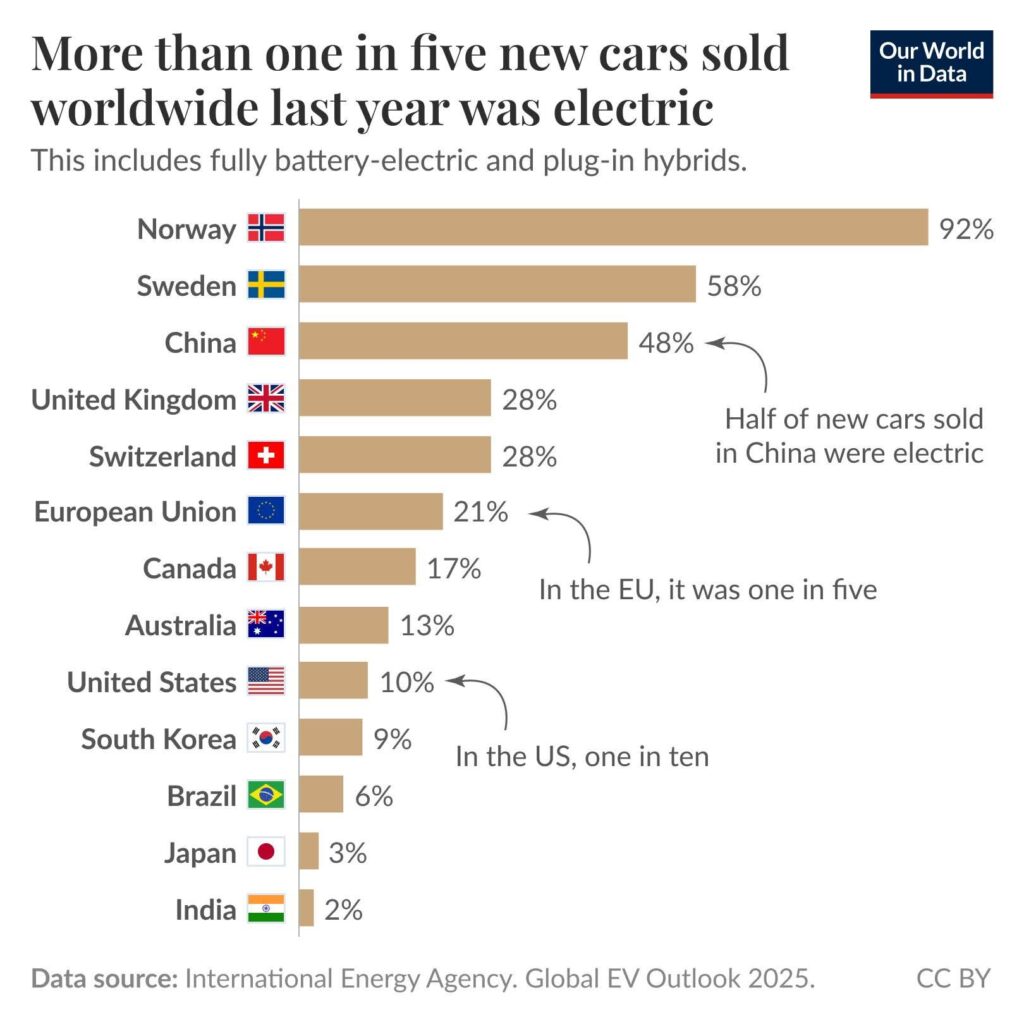
In China in June 2026, sales of New Energy Vehicles (NEV’s) which include Battery Electric Vehicles (BEV’s) and Plug-In Hybrids (PHEV’s) were 47% of all cars. NEV’s now make up 12% of civilian vehicles driving on Chinese roads. I heard a report of someone visiting Shanghai and they said how quiet the traffic was.
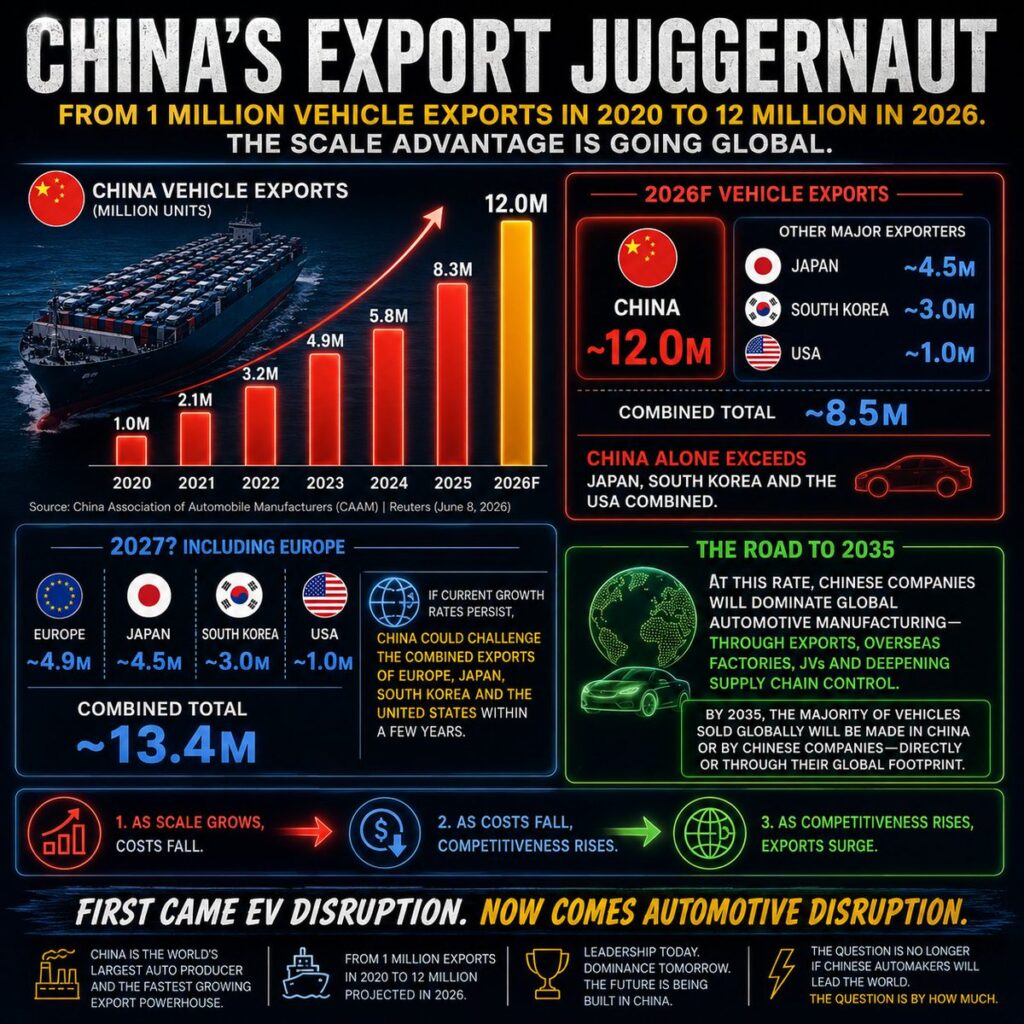
In 2025 China built 34 million vehicles, more than any other country. What is significant is that China’s vehicle exports have gone from 1 million in 2020 to 12 million in 2026. Other major car exporters are Europe, Japan, South Korea and USA with a combined total of 13.4 million.
Octopus supply electric cars (see https://octopusev.com/cars). With the recent further drop in the price in batteries including CATL developing the Sodium Ion battery, I do not think it be long before Electric Cars will cost less than petrol cars as they have so few moving parts.
The sales of electric motor bikes have helped many countries that have electricity from Solar Panels as there are no petrol costs. In India, the Auto Rickshaw three wheeled transport has the additional benefit when electric of lasting longer. The government are installing charging points to promote the sales of electric auto rickshaws in Delhi to help improve the quality of the air in the city.
Information when the web site was launched in 2022
This below information is from when the web site was launched in 2022. So much has happened in only four years with for example half of the cars now sold in 2026 China being electric.
On the page about Power, it says ‘The main problem we have is that much, much more solar and wind power is needed to have enough electric power for heat pumps to replace gas boilers’.
If you look at https://www.energydashboard.co.uk/fourtyeight often half of the nation’s 40 gig watts of electric power is still from gas generators. So, we are a long way off having surplus renewable electricity including for transport.
2025 The National Systems Energy Operator has a very good app showing in real time what is the percentage of wind, gas etc being used to provide the electricity in the country. Suggest search for NESO App. The app is a purple colour
Car Electric Vehicles
Wind and Solar generation costs have dropped dramatically in the past 15 years.
So has the cost of batteries for Electric Vehicles. By 98% in the past 30 years.
Toyota for example have been producing Hybrid vehicles where electricity is put into a small nickel-metal hydride battery when the vehicle slows down, rather than the energy being wasted on heat in the braking system. The vehicle is powered by a normal engine but that is used to generate electricity and the vehicle is powered by an electric motor. So, the engine often switches off in slow moving traffic with the vehicle powered by the electric motor thus reducing pollution in that traffic.
The first Toyota Hybrid was launched in 1997. For an extended history of Toyota Hybrids see https://mag.toyota.co.uk/history-toyota-prius/
There has been a large increase in the buying of full electric vehicles as the price of lithium-ion has dropped in price. However, there are concerns about the environmental impact on these batteries plus what is known as range anxiety where it may be difficult to find a charging point on a long journey.
Not many people often do long distances in their car. I have a Toyota Hybrid Auris and I would like it to be a plug in Hybrid with a larger battery to travel locally say 30 miles.
(ADDED 24-05-22 https://www.moneysavingexpert.com/utilities/electric-vehicles/ )
Heavy Transport
I suggest batteries are not the future for large vehicles. See this article about the Chairman of JCB diggers using Green Hydrogen https://www.msn.com/en-gb/money/technology/billions-go-on-schemes-that-barely-make-a-difference-writes-jcb-boss/ar-AAQfuwE?ocid=msedgntp
There is a large amount of research around the world about efficiently splitting water to create Hydrogen as a power source for vehicles, heating and steel making etc.